The Sticker and the Star: A Rider's Guide to Helmet Safety Ratings in 2026
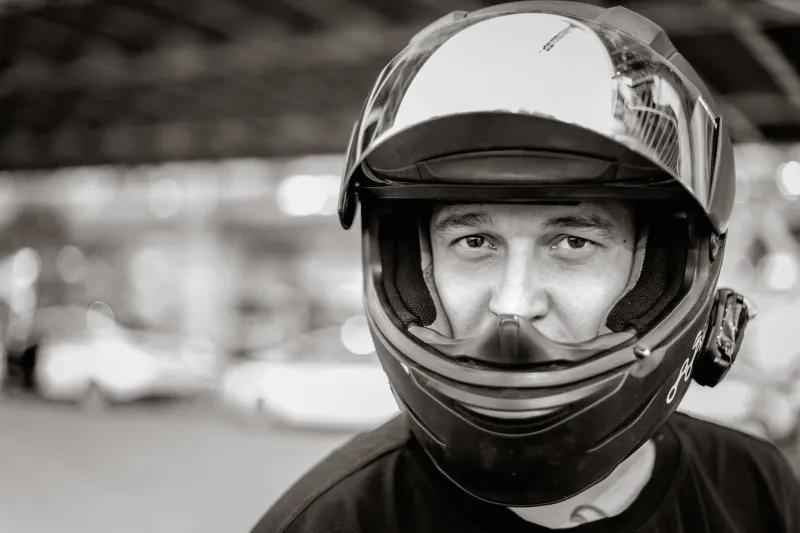
Walk into any UK bike shop and you'll see the same two bits of punctuation doing a lot of heavy lifting: a row of stars and a small approval label. They look like they should settle the argument. They don't. They answer different questions, and neither one can tell you whether a helmet will be comfortable at 70mph on the M4 with a crosswind trying to rearrange your ears.
That's not a reason to ignore them. It's a reason to read them properly. In 2026, with ECE 22.06 now the norm and SHARP still doing its thing, here's how the two fit together — and how to use them in a real buying decision.
What SHARP actually does
SHARP — the Safety Helmet Assessment and Rating Programme — is a UK government-backed scheme that has been scoring helmets since 2007. It's consumer information, not law. A helmet doesn't need stars to be sold; it needs approval. SHARP takes helmets that are already approved and pushes them harder through a set of impact tests, then gives them a score out of five.
The useful bit is that it tests the same model you're looking at, not a brand in general. A manufacturer can have a five-star £120 lid and a three-star £500 lid in the same catalogue. It happens. The star rating is also tied to specific sizes in some cases, because a shell that performs well in a medium won't necessarily behave identically in an XL. If you're buying a particular size, check that size.
What SHARP doesn't do is measure everything you care about. It won't tell you if the cheek pads will give you a headache after 40 minutes. It won't tell you if the visor fogs at the first sniff of November. It won't tell you if the helmet is noisy enough to make you regret every motorway mile. Those are real safety issues in their own way — fatigue, distraction and fogged vision cause crashes — but they're not what a star rating is scoring.
What the ECE 22.06 label means
ECE 22.06 is the UN regulation that a helmet must meet to be legally sold and used on the road in the UK and across Europe. Think of it as the entry ticket, not the review score. It covers things like impact absorption at more points around the shell than the old 22.05 standard, retention system strength, visor quality and — importantly — rotational impact testing. That last one matters because real crashes rarely involve a perfectly square hit.
A helmet with 22.06 approval has cleared a bar. It has not necessarily cleared it by the same margin as another helmet. That's the gap SHARP tries to fill. One is the legal minimum with a bit of extra rigour built in; the other is a comparative score. Neither is a guarantee. A five-star helmet can still be the wrong helmet for you if it doesn't fit.
The myths worth binning
"Five stars means it's the safest helmet in the shop." It means it scored well in SHARP's tests. Another five-star helmet may score similarly, and a four-star helmet may suit your head shape better and sit more securely. Fit beats a star.
"ECE 22.06 means cheap helmets are fine." Cheap helmets can absolutely be fine. They can also be uncomfortable, noisy and short-lived. Approval is a floor, not a ceiling.
"More money buys more stars." Sometimes. Often not. You're paying for shell materials, lining quality, brand, graphics and dealer margin. A £500 lid isn't automatically safer than a £150 one; it's usually more pleasant to live with. Check the specific model.
"The brand is five-star across the board." Brands don't get stars. Models do. Sizes do. Check the exact helmet you're about to pay for.
"SHARP tests everything." It doesn't. Plenty of helmets never get rated. No rating is not the same as a bad rating — it just means nobody has put that model through the scheme.
How to compare two helmets without losing the plot
Start with the legal stuff. Both helmets should have ECE 22.06 approval and a visible label. If one doesn't, walk away — it's not a 2026 road helmet, whatever the shop assistant says.
Then check SHARP for the exact model and size. If both are rated, compare like for like. If one isn't rated, don't treat that as a red flag by itself; treat it as missing information.
Next, ignore the label for ten minutes and put the thing on. A helmet that doesn't fit will fail you in ways no star rating can predict. You want even pressure across the crown, firm but not painful cheeks, no sharp hot spots at the forehead or temples, and a shell that doesn't shift when you try to roll it off your head with the straps undone. Then do the straps up and check the retention system sits where it should, not over your throat.
Finally, think about the riding you actually do. A commuting lid needs to be easy to live with: visor changes, fog control, glasses compatibility, a decent chin curtain. A track-day helmet needs a different set of compromises. SHARP and ECE are the same for both; your use case isn't.
A short showroom checklist
- Look for the ECE 22.06 approval label and check it matches the helmet you're buying — not just the display model.
- Search SHARP for the exact model and size, not the brand.
- Try the helmet on for at least ten minutes. Walk around. Sit on a bike if you can.
- Do the roll-off test with the straps undone. It should resist lifting cleanly off your head.
- Fasten the strap and check the buckle sits flat and doesn't dig in.
- Check the visor for optical distortion and make sure it's the right tint for road use. Clear for dark hours, always.
- Ask about the date code if you're buying an older model. A helmet that's been on a shelf for years isn't the same as a fresh one.
- If it's noisy, price in earplugs. If it fogs, price in a Pinlock. Those are part of the real cost.
The bottom line
SHARP stars are useful. ECE 22.06 is essential. But a helmet is a fitted safety product, not a fridge with an energy label. The sticker tells you it's legal; the star tells you how one model performed in a specific set of tests; your head tells you whether it's actually going to work. Use all three, in that order, and you'll make a better call than the person who just buys the one with the most stars on the shelf.
Ride safe, and don't let a label do your thinking for you.